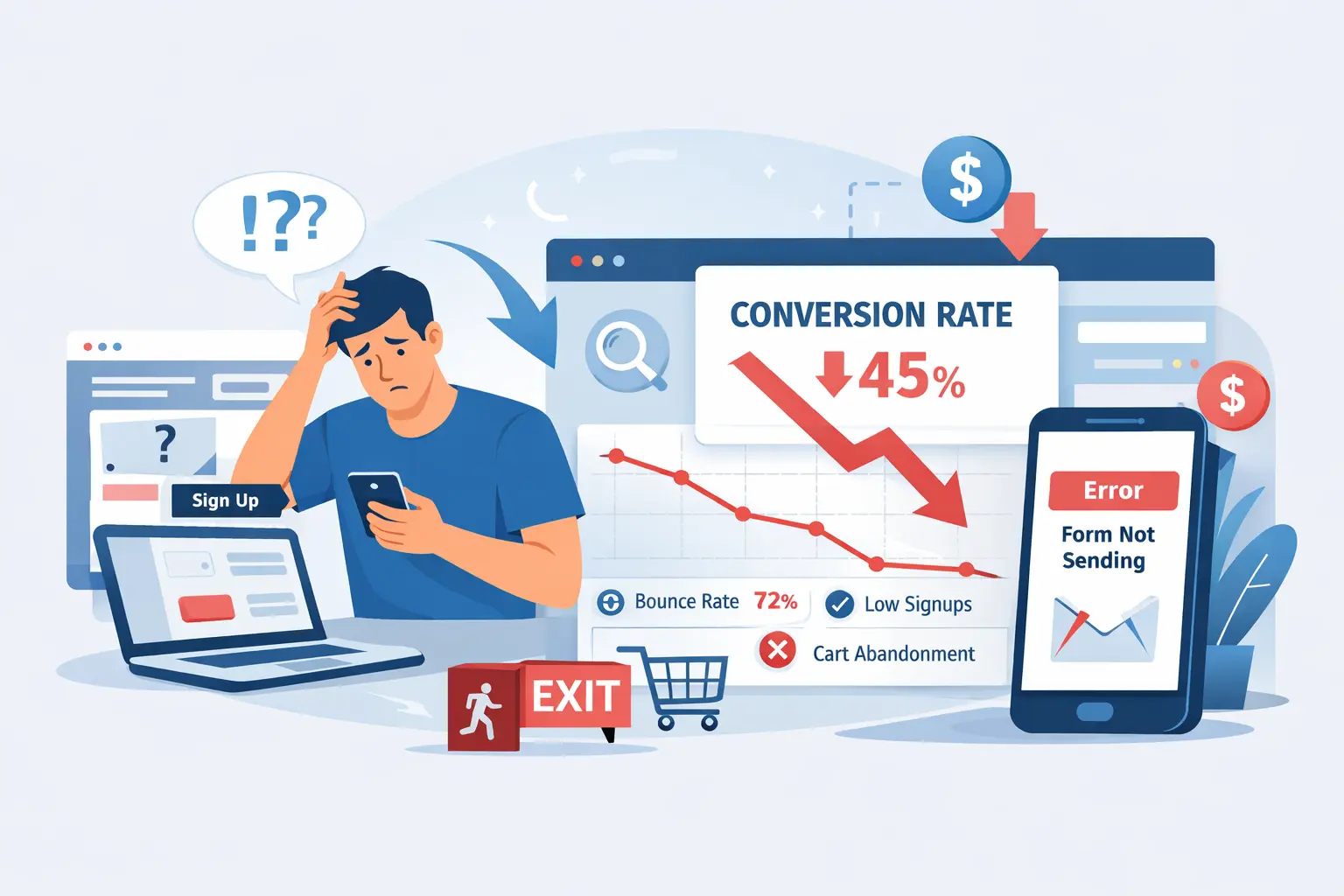

There’s a meeting that happens in almost every business we’ve worked with. Someone pulls up the website or app, everyone agrees it looks professional, and then someone quietly mentions that the numbers aren’t moving. Signups are low. Users drop off. Sales aren’t converting.
The instinct is to blame marketing — maybe traffic is wrong, maybe the ads aren’t targeted enough. But the real answer is usually sitting right in front of everyone: the experience itself. Not the design. The experience.
UI (User Interface) is what your product looks like — colors, typography, layout, icons. UX (User Experience) is how it feels to use it — how fast someone can find what they need, how intuitive the flow is, and whether they get what they came for.
You can have a beautiful UI and terrible UX at the same time. In fact, that’s more common than you’d think. A homepage with stunning visuals but a confusing navigation menu. A checkout page with five unnecessary steps. A mobile app where the most important button is hidden by the keyboard. These are UX failures hiding behind good aesthetics.
1. Designing for yourself, not your user
The single biggest UX mistake is building for your own aesthetic preferences instead of testing with actual users. What feels obvious to your team is often invisible to a first-time visitor. Real UX work involves watching real people use your product — and being humble enough to change things when they struggle.
2. Burying the call-to-action
People don’t scroll to find out what to do next. If your primary action — book a call, get a quote, start a trial — isn’t immediately visible on every key page, you’re losing people who were actually interested. CTAs should be prominent, clear, and repeated at logical decision points throughout the page.
3. Treating mobile as an afterthought
In India, over 70% of web traffic is mobile. Designing desktop-first and adapting for mobile later produces broken experiences — menus that don’t open, forms that are impossible to fill, text that spills outside the screen. Mobile-first thinking has to be baked in from the start, not bolted on at the end.
When UX is done well, it shows up in your numbers — not just in design awards. Lower bounce rates, higher time-on-page, more form completions, better retention, and stronger repeat visits. These aren’t soft metrics. They directly affect revenue.
Companies that invest in continuous UX improvement consistently outperform competitors on conversion, customer satisfaction, and lifetime value. UX is not a project with an end date. It’s an ongoing commitment to understanding and serving the people who use what you build.
Web design focuses on the visual appearance — layout, colors, fonts, imagery. UX design focuses on the user’s journey: how they move through your product, where they get confused, and whether they achieve their goal. A good UX designer thinks about information architecture, user flows, and interaction patterns. Both matter, but UX has a more direct impact on business outcomes like conversions and retention.
Some clear signals: high bounce rates (above 60–70%), low time-on-page, poor conversion rates despite decent traffic, or customer feedback mentioning confusion. Tools like heatmaps (Hotjar, Microsoft Clarity) and session recordings can show you exactly where people drop off — often in places that surprise you. A proper UX audit can identify the top issues systematically.
Not at all. Even a five-page business website has UX — whether it’s intentional or not. A small business with a clear, easy-to-navigate site that loads fast on mobile will always outperform a larger competitor with a cluttered, confusing one. Good UX is proportionate to your product’s complexity, but the principles apply universally.
A focused UX audit typically takes 2 to 4 weeks and results in a prioritised list of improvements. A full UX redesign from research and wireframing through to final implementation — usually takes 6 to 16 weeks depending on scope. We always recommend starting with an audit before committing to a full redesign.
Yes — and that’s one of the advantages of working with us. Our UI/UX team works directly alongside our web and software development teams, which means designs aren’t lost in translation during handoff. We handle everything from initial research and wireframing to high-fidelity design and full development, so you get a consistent, well-executed product end to end.