
Sistemas Strengthens AWS Security Posture and Modernizes Database Infrastructure with OneData
Learn how Sistemas partnered with OneData to strengthen AWS security governance, improve threat detection visibility, automate identity and credential controls, protect sensitive data, and modernize its legacy SQL Server infrastructure using AWS-native security, compliance, monitoring, and migration services.
Benefits
95%
CIS AWS Foundations Benchmark compliance achieved
82%
Reduction in security findings through automated governance, centralized monitoring, and remediation workflows.
100%
Encryption coverage across AWS workloads, including Amazon RDS, Amazon EBS, Amazon S3, CloudTrail logs, and backup data.
Zero
Public S3 buckets remaining after remediation.
35%
Reduction in third-party security tooling costs by adopting AWS-native security services.
40%
Reduction in operational effort for security administration through automation, centralized monitoring, credential lifecycle management, and managed AWS security controls.
Zero data loss
Database migration completed with validation, minimal downtime, and maintained data integrity.
About the Customer
Sistemas is a Mexico-based technology solutions provider focused on delivering IT infrastructure, cloud, and digital transformation services. The company supports organizations in modernizing operations through scalable and secure technology platforms designed to improve operational efficiency, reliability, and long-term business growth.
As part of its own modernization journey, Sistemas needed to strengthen cloud security governance, protect sensitive business data, improve compliance visibility, automate credential management, and modernize its legacy Microsoft SQL Server 2016 database infrastructure on AWS.
Overview
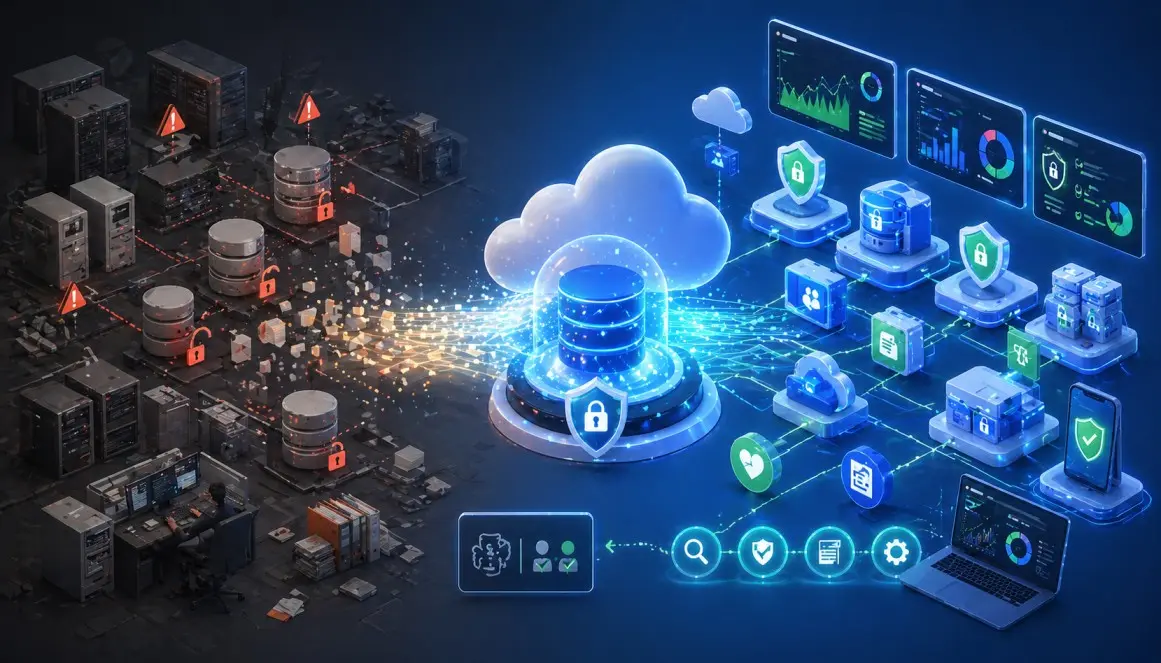
As part of its cloud modernization initiative, Sistemas identified the need to strengthen security governance across its AWS environment while modernizing its legacy SQL Server infrastructure.
The existing environment presented operational and security challenges related to inconsistent encryption practices, manual credential management, limited audit visibility, fragmented monitoring capabilities, and the absence of automated compliance validation. In addition, the organization’s on-premises SQL Server 2016 environment required modernization to improve scalability, resilience, security, and operational efficiency.
To address these requirements, Sistemas partnered with OneData to implement AWS-native security controls, automated governance frameworks, centralized monitoring, data protection controls, identity security improvements, and database modernization using Amazon RDS and AWS Database Migration Service.
The engagement focused on four major security and modernization domains: data protection, identity and access management, security monitoring and governance, and secure database migration. The solution used AWS-native managed services to reduce operational complexity while improving visibility, compliance, and protection of business-critical data.
Overview
As part of its cloud modernization initiative, Sistemas identified the need to strengthen security governance across its AWS environment while modernizing its legacy SQL Server infrastructure.
The existing environment presented operational and security challenges related to inconsistent encryption practices, manual credential management, limited audit visibility, fragmented monitoring capabilities, and the absence of automated compliance validation. In addition, the organization’s on-premises SQL Server 2016 environment required modernization to improve scalability, resilience, security, and operational efficiency.
To address these requirements, Sistemas partnered with OneData to implement AWS-native security controls, automated governance frameworks, centralized monitoring, data protection controls, identity security improvements, and database modernization using Amazon RDS and AWS Database Migration Service.
The engagement focused on four major security and modernization domains: data protection, identity and access management, security monitoring and governance, and secure database migration. The solution used AWS-native managed services to reduce operational complexity while improving visibility, compliance, and protection of business-critical data.
Opportunity | Strengthening Security Visibility and Reducing Operational Risk
Sistemas identified multiple operational and security risks within its existing environment that increased the complexity of maintaining secure and compliant cloud operations.
The organization lacked centralized monitoring and audit visibility across workloads, limiting the ability to continuously monitor activity, validate configurations, identify potential exposure risks, and support investigation workflows.
Manual IAM credential management increased the risk of credential exposure. IAM access keys required stronger lifecycle controls, while password policies needed to be standardized to improve authentication security.
Encryption practices were inconsistent across workloads, creating gaps in data protection and compliance alignment. Sistemas needed a centralized encryption strategy for databases, storage volumes, logs, backups, and sensitive operational data.
Security visibility across workloads was also limited, making it difficult to identify external access risks, monitor API activity, assess vulnerabilities, detect anomalous behavior, and consolidate findings across the environment.
The organization also lacked automated compliance validation. Without continuous configuration assessment, it was harder to detect configuration drift, validate alignment with CIS AWS Foundations Benchmark requirements, and maintain audit readiness.
At the same time, the organization’s legacy SQL Server 2016 infrastructure required modernization to address scalability, maintenance, database security, backup management, and long-term operational resilience.
These challenges highlighted the need for a structured security and governance framework capable of improving monitoring visibility, automating remediation processes, strengthening identity and access controls, standardizing encryption, improving vulnerability assessment, and modernizing the database environment using AWS-native services.
Solution | Implementing AWS-Native Security Controls and Database Modernization
To address these challenges, Sistemas partnered with OneData to implement a structured AWS-native security and governance framework while modernizing its legacy database infrastructure.
Identity and access management controls were strengthened through enhanced password policies, automated IAM access key rotation, and least-privilege validation processes. Sistemas implemented a standardized IAM password policy requiring a minimum length of 14 characters, uppercase, lowercase, numeric, and special characters, password expiration after 90 days, and prevention of password reuse.
AWS Lambda was implemented to automatically detect and rotate IAM access keys older than 90 days. Amazon SNS notifications supported operational awareness, Amazon S3 logging provided audit visibility, and failed operations were sent to Amazon SQS for reliable retry handling. This reduced manual administration while improving credential security and auditability.
IAM Access Analyzer was used to continuously evaluate resource policies and identify external resource access, unused permissions, excessive privileges, and public resource exposure. Findings were reviewed and remediated using least-privilege principles.
To improve security monitoring and investigation visibility, AWS CloudTrail, AWS Config, AWS Security Hub, and IAM Access Analyzer were deployed to continuously monitor API activity, validate configurations, identify external access risks, and centralize security findings across the environment.
AWS CloudTrail captured API activity across AWS Regions, providing centralized audit logging, investigation support, security event tracking, and compliance reporting. Logs were encrypted using AWS KMS and securely stored in Amazon S3.
AWS Config continuously evaluated infrastructure configuration against defined security policies, enabling continuous compliance assessment, configuration history, configuration drift detection, and security rule evaluation. AWS Security Hub centralized findings from Amazon GuardDuty, Amazon Inspector, and AWS Config into a single dashboard, simplifying security operations by providing a unified view of the organization’s security posture.
Amazon GuardDuty was implemented to continuously monitor AWS CloudTrail events, Amazon VPC Flow Logs, and DNS logs. Machine learning and anomaly detection helped identify suspicious activity, including anomalous API usage, credential compromise indicators, and unusual network behavior. Amazon Inspector continuously assessed compute resources for operating system vulnerabilities, software package vulnerabilities, and security exposure, with findings prioritized by severity for timely remediation.
Security findings, audit logs, and operational telemetry were continuously reviewed through centralized monitoring workflows to support incident investigation, operational analysis, and coordinated remediation activities across the AWS environment. Event-driven alerting and operational escalation workflows were implemented to improve visibility into high-priority security findings and support continuous monitoring aligned with AWS security best practices.
Security remediation and hardening activities included eliminating unintended public access risks, implementing Amazon VPC isolation and private subnets, enforcing security group restrictions, enabling encryption by default, and automating governance controls to reduce manual operational effort.
Encryption controls were implemented across workloads using AWS Key Management Service with Customer Managed Keys. Controls included Amazon RDS encryption at rest using AWS KMS, Amazon EBS encryption for EC2 storage volumes, Amazon S3 server-side encryption using SSE-KMS and SSE-S3, AWS CloudTrail log encryption, backup encryption using AWS KMS, automatic KMS key rotation, and eight Customer Managed Keys deployed for workload separation. These controls helped ensure sensitive information remained encrypted throughout its lifecycle while supporting centralized key management and auditability.
Database credentials and application secrets were moved from manual configurations into AWS Secrets Manager. This enabled centralized secret lifecycle management, reduced credential exposure, supported secure retrieval by applications, simplified credential rotation, and improved alignment with security best practices.
In parallel, OneData helped Sistemas migrate its on-premises SQL Server 2016 database to Amazon RDS for SQL Server using AWS Database Migration Service. The migration used a full-load migration approach with validation processes designed to maintain data integrity and operational continuity throughout the transition. The detailed migration architecture included Microsoft SQL Server 2016 as the source database, Amazon RDS SQL Server 2017 Express as the target database, AWS DMS as the migration tool, a dms.t3.small replication instance, and full-load migration with validation.
The target database environment was configured with encryption at rest using AWS KMS, backup encryption using AWS KMS, private database deployment inside Amazon VPC, database credentials stored in AWS Secrets Manager, audit logging through AWS CloudTrail, vulnerability monitoring through Amazon Inspector, and compliance monitoring through AWS Config.
OneData also established an ongoing security governance process to support continuous improvement after implementation. This included reviewing IAM permissions, monitoring access key lifecycle status, reviewing Security Hub findings, validating AWS Config compliance, analyzing GuardDuty and Inspector findings, strengthening encryption and secrets management practices, and improving governance controls as the AWS environment evolved.
Outcome | Improving Security Governance, Compliance, and Operational Efficiency
Following the implementation, Sistemas achieved significant improvements in security governance, monitoring visibility, compliance alignment, database modernization, and operational efficiency.
95%
Achieved 95% alignment with CIS AWS Foundations Benchmark requirements through AWS Config, AWS Security Hub, IAM policy improvements, encryption controls, audit logging, and remediation workflows.
82%
Reduced security findings by 82% through automated governance, centralized monitoring, policy hardening, encryption standardization, public access remediation, and ongoing security review workflows.
100%
Enabled 100% encryption coverage across AWS workloads, including database, storage, logs, backups, and supporting services. The implementation used AWS KMS Customer Managed Keys to centralize encryption governance and support workload separation.
Zero
Eliminated public S3 bucket exposure risks across the environment through public access remediation, policy review, and continuous monitoring.
centralized
Established centralized multi-region audit logging and monitoring visibility using AWS CloudTrail, Amazon S3, AWS Config, AWS Security Hub, Amazon GuardDuty, Amazon Inspector, and IAM Access Analyzer.
35%
Reduced reliance on third-party security tooling, resulting in 35% cost savings by adopting AWS-native security services for monitoring, governance, threat detection, vulnerability assessment, audit logging, and compliance validation.
40%
Reduced operational overhead by 40% through automation and governance controls, including Lambda-based IAM access key rotation, SNS notifications, S3 audit logging, SQS retry handling, centralized compliance monitoring, and managed database operations through Amazon RDS.
Zero data loss
Completed database migration with zero data loss and less than two hours of downtime using AWS Database Migration Service, full-load migration, validation, and secure Amazon RDS configuration.
The implementation also delivered broader business benefits, including automated credential lifecycle management, improved audit readiness through centralized logging, increased visibility across AWS workloads, stronger compliance alignment with the CIS AWS Foundations Benchmark, simplified database administration through Amazon RDS managed services, and improved vulnerability visibility through Amazon Inspector.
The engagement reinforced several cloud security best practices for Sistemas: enabling encryption by default for all workloads, centralizing audit logging from the beginning of cloud adoption, automating credential management to reduce operational risk, using AWS-native managed security services to simplify governance, continuously monitoring infrastructure configuration for compliance, and integrating security monitoring into day-to-day operations rather than periodic reviews.
With AWS-native security controls, centralized governance, automated identity controls, encrypted workloads, secure database migration, and a modernized database platform in place, Sistemas is better positioned to maintain compliance alignment, reduce operational risk, protect critical organizational data, and support scalable cloud operations through continuous monitoring and automated security management.
Build a more secure and cost-efficient
AWS environment
Partner with OneData to optimize your cloud infrastructure, reduce costs, and
strengthen security—without compromising performance.